"I had already learned that everything I did not understand probably had something to it." – from A Moveable Feast, by Ernest Hemingway.(1899-1961)
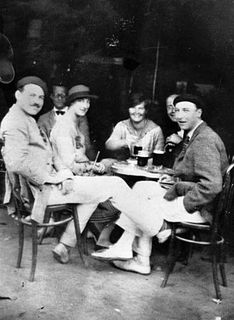 I have spent a lot of time over my life with people I've never met who lived during a time I never saw. I encountered these people and places in the course of what used to be called a liberal education. I think about them a lot. F. Scott Fitzgerald and Zelda, Ernest Hemingway (at far left, with friends) and Mary, his wife at the time; Gertrude Stein and her impressive salon, all of these became part of the mythology of my youth, introduced to me through novels and by high school English teachers and college professors. These were the creators of some of the greatest literature of the 20th century.
These characters inhabited an environment in the 1920s and '30s that I didn't understand, but seemed to have "something to it." They remain comfortable friends in my imagination. As a romantic, I picture these folks spending long, sweet hours at tables along the Left Bank drinking coffee in the morning, wine in the afternoon, and absinthe in the evening, meanwhile discussing the great issues of the day including the literature and art of the world. In truth, the days may have often been painful since all of them were short of money. But they were, themselves, great artists. Even their discomfort seems, somehow, comfortable because of how eloquently they describe their lives. I don't have to walk up dark stairways with them into insect-infested flats. I can just imagine them swapping stories and looking grand in their berets.
In real life, I've spent countless hours with another group of artists. I've watched caregivers shepherd babies into the world, hoisting them into the bright light of the world and into their mother's arms. I've been with nurses as they heal and comfort the terminally ill in their last moments. I've stood by physicians as they have healed broken bones, repaired damaged hearts and offered the mysterious power of their presence to patients with cancer.
The truth is, I don't real understand any of this. As Renoir wrote: "Great art is inimitable and indescribable." It is the mysteries that matter most. I don't know why some caregivers are able to bring healing with actions as subtle as a soft voice or the strength of a firm hand. I can't tell you why the encounters of patients and caregivers so often seem to me like they should be captured, framed and hung on the wall.
Somehow, beauty often lives in the most unlikely surroundings. Hospitals are not perceived like art museums. Yet, masterpieces are created in them every day. I don't quite understand this, so there's probably "something to it."
What do you think?
-Erie Chapman


 Journal of Sacred Work
Leave a comment