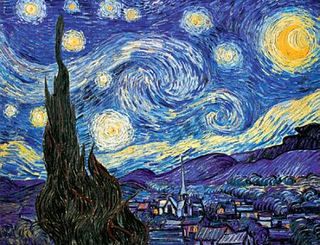
 Many years ago I heard a fascinating lecture by an ophthalmologist on the impact of failing eyesight and other eye diseases on the work of major artists. This physician contended that the work of some artists changed, and sometimes became richer, because their changed eyes caused them to use odd color combination's and distorted angles.
Did Rembrandt's age affect the genius of his work? In another way, was it Van Gogh's distorted brain chemistry that caused him to create some of the most striking and beautiful masterpieces in history? Did cocaine help Edgar Allan Poe scare us with his horror stories? Did alcohol influence the creation of some of F.Scott Fitzgerald's finest stories?
Some psychiatrists might contend that we are our brain chemistry. Certainly, our personalities including our moods and the way we behave are enormously impacted by our state of mind.
As an assistant district attorney, I often prosecuted criminals who claimed they were "out of their minds" when they committed a particular violent act and that their criminal action was not "who they really are."
How do you see the patients who come to you for care? I believe our concept of the humanity and soul of another often has a big impact on the quality of care many receive.
If you, as my caregiver, can understand that my irritability and anger is a function of my fear and not a personal attack on you, than perhaps I can give you better care. If you hear my anger as a personal attack on you, how might it affect your care of me? Will my call light be ignored? Will I be labeled as a "problem patient" on your chart and be discriminated against by other caregivers?
The thing I've never liked about the brain chemistry idea is that it always seems to demean human individuality and accomplishment. If I'm not responsible for mistakes caused by my brain chemistry than I guess I don't get any credit for any good stuff I've done. My good acts, after all, must have been because my brain chemistry was balanced just right.
Should we praise Van Gogh for his genius or write it off to brain chemistry? Should we honor Mother Theresa or just say she was driven toward sainthood by some kind of obsessive disorder?
Classifying people by disease states can be hazardous to the humanity of both patients and their caregivers. If a sick human being becomes merely "the gall bladder in 4028" then who is the caregiver? If we think of ourselves as simply a combination of chemicals, than how does our soul find expression?
What do you think?
-Erie Chapman


 Journal of Sacred Work
Leave a comment