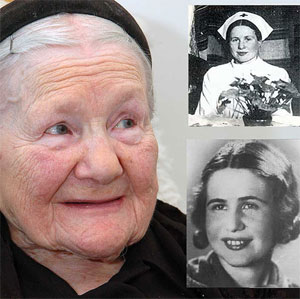
"I kept silent. I preferred to die rather than to reveal our activity." Irene Sendler( below) who helped rescue thousands of children from the Warsaw ghetto during World War II.
While suffering the hell of a Nazi concentration camp, Dr. Victor Frankl found himself face to face with the hardest existential question there is: Do our lives matter?
Within Frankl's immediate gaze, lives were being snuffed out by the hundreds each day. And these were not just the lives of adults. Innocent children were murdered as if they had done something wrong. If babies were born to prisoners, they were put to death within moments of arriving in the earth.
How could life matter when it was treated so cheaply? How could any one life have any meaning if it only lasted a few seconds?
Dr. Frankl found his answer. He wrote about it in the seminal book, Mans Search for Meaning. What Frankl proposed was that whether life actually matters or not, we need to believe that it does.
In the concentration camp, where all prisoners were on starvation diets, Frankl observed that those who gave up on life would die within twenty-four hours. On the other hand, those in the same physical condition who sustained hope (including Frankl) were also the ones who were much more likely to survive.
One person who also found meaning in the midst of horror was Irene Sendler. I found out about her from a blog written by a man identified, simply, as "Peter." [His blog is called Bayou Renaissance Man.] Sendler may never have asked herself the "meaning" question. Instead, as a social worker granted access to the Warsaw ghetto in 1940 to check for typhus, she constantly risked her well-being not only with her caregiving, but by smuggling Jewish children out of the ghetto. She gave them fake, Catholic identities so that they might survive outside the ghetto. Sendler was arrested by the Nazis in 1943. In the face of torture, she refused to reveal the names of any children or anyone who had helped her. She was sentenced to death, but escaped when a bribed guard dumped her into the woods after her arms and legs had been broken.
Perhaps the core question of existentialism is wrong. Maybe it does not matter if we matter. Maybe all we need is to believe, like Frankl, that our lives find their meaning, for us, through living as if our actions, however small, are important.
Hope rises from the belief that we are all special beings. Whether a baby lives only a few seconds or an adult lives one hundred years, our lives can always be reflections of God's Love. With Love, everything matters. Without Love, nothing matters. As for Irene Sendler, she died just this year, on May 12, 2008, at the age of 98. To her dying day, her question was not whether she mattered, but why she hadn't saved even more children.
What do you, as a caregiver, think? Is there anything that matters without Love?
-Erie Chapman


 Journal of Sacred Work
Leave a reply to Edwin Loftin Cancel reply