"Today I wrote some words that will see print. Maybe they
will last forever and that someone will read them there, ink making a
light scratch on his mind or hers." – John Updike
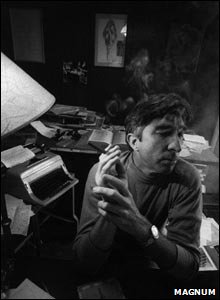
When the great American writer John Updike passed away last week (January 27, 2009 – lung cancer) at the age of 76 I felt a lump rising in my throat. I had no idea he was sick. I had no notion he was so young. Like all great writers I've encountered, he created characters that have become a part of my life and the life of millions. Author Nicolas Delbanco said that Updike was a great writer because he had an especially "noticing eye." And that is what all great caregivers have, a "noticing eye" that sees suffering, sees the pathway to healing, and takes it. Updike made more than a "light scratch" on the minds of so many.
Updike won almost every literary award a writer can win. His work, especially his Rabbit quadrilogy (beginning with Rabbit Run) is considered to be among the best writing of the 20th century. You may also know him as the author of the Witches of Eastwick, made into a movie starring Jack Nicholson.
What does Updike's life have to do with caregiving? It was words by Updike and others talking about him that may help us better understand the way in which our striving enriches our spiritual energy. Our tendency to think what we say, write and do is important only if we get credit for it turns out to be a mistake. It is the act of creating and of appreciating creations that enriches us, and sometimes others.
This is true of caregivers. When we strive to live Love in caring for others, applause from the patient or from a supervisor for our efforts is not what matters. Our spirits, and the collective spirit of the world, are enhanced by such efforts.
In a recent Vanity Fair Magazine article, actor Dustin Hoffman was asked his motto. He quoted Oscar Wilde: "The true mystery of the world is the visible. Not the invisible."
Since caregivers are always so busy, it may seem a chore to read an Updike book or other writing. Yet, perhaps this little sample from an Updike writing that "saw print" called "The Rescue" will offer some insight into the heart of a man with a "noticing eye."
I think back with greater satisfaction upon a yellow
bird, a gold finch that had flown into the garden shed and could not
get out, battering its wings on the deceptive light of the dusty,
warped, shut window.
Without much reflection for once, I
stepped to where its panicked heart was making commotion, the flared
wings drumming, and with clumsy, soft hands pinned it against a pane,
held loosely cupped this agitated essence of the air, and through the
open door released it like a self-flung ball to all that lovely,
perishing outdoors. – John Updike
-Erie Chapman


 Journal of Sacred Work
Leave a comment