Hope is the thing with feathers
That perches in the soul,
And sings the tune–without the words,
And never stops at all…
Emily Dickinson (1830-1886)
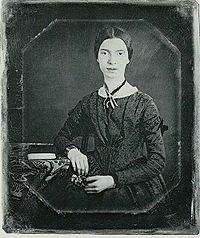
[The only authenticated photograph of Emily Dickinson]
"I am small, like the wren, and my hair is bold, like the chestnut bur,
and my eyes like the sherry in the glass that the guest leaves." (Emily Dickinson, in a letter to Thomas Higgenson)
She never mothered a child or was married. Yet, her words live as deep spiritual gifts for caregivers willing to unwrap them.
No matter how often I encounter her, I never cease to be astounded by the gorgeous contributions of this hermit-like woman. That is why I have written about her before and recommend her to caregivers again.
In all of her later years, Emily was so shy (I like to call her Emily because it makes me feel like her friend) that she sometimes refused to meet guests face to face, encountering rare visitors by talking with them while sitting out of sight in another room. She spent most of her life in a single bedroom in a single house in Amherst, Mass. From there she wrote words that continue to illuminate hearts around the world.
This poet's story is impossible. As unlikely as that of Vincent Van Gogh or Edgar Allen Poe.
Today, Emily's behavior would no doubt draw visits from psychiatrists, pronouncements of a personality disorder, and prescriptions for Prozac. Back then, she found expression by penning some of the finest poems ever written by an American. Today, it would be so difficult to find the silence Emily lived in every day. How slow her hours would seem to we who live surrounded by electric noise. To think that only seven of Emily's hundreds of poems were published in her lifetime is to mourn the blindness of her contemporaries who failed to recognize the jewel among them.
Intrigued by the mystery of her life, modern American and poet laureate Billy Collins imagined himself into Emily's bedroom with an intimacy no man of her time ever experienced. His poem brings us into her presence in a startling fashion. His writing is called "Taking Off Emily Dickinson's Clothes" and may be found easily on the internet. It begins:
First, her tippet made of tulle,
easily lifted off her shoulders and laid
on the back of a wooden chair.
And her bonnet,
the bow undone with a light forward pull…
Collins engages an eloquence that flows from describing details and actions with an exquisite attention that recommends itself to countless men who wonder how to join love-making with grace. Collins own precious gift was learned, in part, from Dickinson herself. His delicate undressing of the imaginary Emily draws us, perhaps, a bit closer to this woman who would never have bared her body to a man but who opened her soul to us all.
In a different way, I rarely experience personal pain without thinking of another of Emily's immortal poems:
After great pain, a formal feeling comes
The Nerves sit ceremonious, like Tombs
The stiff Heart questions was it He, that bore,
And Yesterday, or Centuries before?
The Feet, mechanical, go round
Of Ground, or Air, or Ought
A Wooden way
Regardless grown,
A Quartz contentment, like a stone
This is the Hour of Lead
Remembered, if outlived,
As Freezing persons recollect the Snow
First-Chill-then Stupor-then the letting go
Emily writes to us across the ages about "hope, the thing with feathers," and offers us that hope and grace to this day. Do we hear her? Just now, you may imagine Emily Dickinson, sitting in the next room, her hands in her white-dressed lap. How does she speak to you…and you to her?
-Erie Chapman


 Journal of Sacred Work
Leave a reply to ~liz Wessel Cancel reply