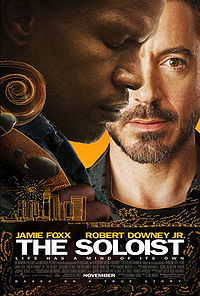
 Nathaniel Anthony Ayers, Jr. can play Beethoven on the cello with the gift of a naturally blessed musician who has struggled to develop his talent. But, his audience, until recently, was made up of homeless folks on the streets of Los Angeles. "I'm not always sure what's going on," Ayers says through the voice of actor Jamie Foxx in the new movie, The Soloist, based on the true story of the lives of Ayers and Steven Lopez, the L.A. Times columnist who brought Ayers story to public attention. The problem for Mr. Ayers is that the blessing of his talent is counterbalanced by the terrible curse of schizophrenia. For most of his life, Ayers has lived in another world, a world occupied with voices over which he has no control.
As a caregiver, you will have encountered perhaps many who live different worlds. I speak not only of Alzheimer's patients but of typical patients as they fall under the influence of anethesia, alcohol or other mind-altering drugs.
Meet my new friend Don. Don has a gift. He can recall the batting averages of most major league baseball players and how each team did, whether the match was yesterday or maybe a few years ago. He can do the same "trick" with football. I didn't ask him about other sports. But I know that most of Don's day is occupied thinking about sports. So what? Isn't that true of lots of people?
The problem is, Don doesn't know how to answer questions in a typical job interview. This is because most of his brain functions at a level most experts would describe as about second grade.
Don's friend Billy has a gift for remembering people's names. This would seem like a handy talent. Again, a problem arises when you put Billy's ability in a setting run by people like you and me. When I met Billy, he immediately wanted to know not just my name but the exact spelling. When he got it straight, he turned to his fifteen or so colleagues in the day program at Progress, Inc (a Nashville charity) and shouted very loudly, "Hey everybody, THIS IS ERIE CHAPMAN!" "He'll remember your name forever," Donna Goodacre, head of the Center told me. Come back in ten years and he'll shout, "Hi, Mr. Chapman!"
The folks at Progress, Inc are used to Billy. None of them responded to his announcement of my arrival. They are each living in their own consciousness and their different world leaves them isolated from the existence most people inhabit.
How do we, as caregivers, build bridges for these afflicted beings so that they may join our "world?" Sometimes we can't. Sometimes, it's better if we don't even try. The consciousness of our world is not always a place we enjoy ourselves. And that is why some who have been traumatized by life develop amnesia or other ways of escape.
What we can bring to Nathaniel and Don and Billy, and to each other, is the unique gift of Love. Love can be so difficult to find and offer when the patient before us is occupying an awareness far from anything we know.
There are so many stories like the one portrayed in the movie. Schizophrenia afflicts a member of my extended family who is "fine," according to her sister, when "the voices leave her alone." My cousin Ronnie was born just hours before me in 1943. His mother's case of German Measles meant that Ronnie would be permanently deaf and unable to speak as well as profoundly challenged mentally. Another aunt of mine fell off the delivery table during the birth of my cousin, Doug. That was fifty years ago. Doug is "fine" according to his family. If you met him, you would like him. And, you would also know, instantly, that there is something "different" about Doug. He occupies a different world.
Perhaps all of us do.
-Erie Chapman


 Journal of Sacred Work
Leave a reply to ~liz Wessel Cancel reply