Journal of Sacred Work

Caregivers have superpowers! Radical Loving Care illuminates the divine truth that caregiving is not just a job. It is Sacred Work.

About

"If I speak in the tongues of mortals…but do not have love, I am a noisy gong…" – 1 Corinthians 13:1 (NRSV)
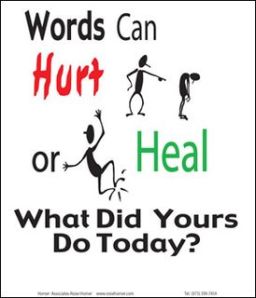
Words_can_Hurt_or_Heal_small    One of the first word combinations my 18-month year old grandaughter has learned is a powerful two-word phrase. "My turn," she said to me on the phone a couple days ago. Her mother taught her words about taking turns in the milieu of the playground to minimize the customary squabbles with other children.

   No sooner do we learn, as small children, to say words than we discover that we are not free to speak as we wish. If we don't find the "right" words to use and the "right" way to say them, we may well find ourselves shunned.

   Within the small circle of my extended family, I have loved ones who sometimes have trouble finding the right words for a variety of reasons. Perhaps we all have moments like this. I know I do. Yet, each of these people have special challenges.

   In talking with her mother, one family member, Eri, struggling with personal issues, has often chosen words of resentment that have rung in her mother's ears like Paul's "noisy gong." Kathy, an in-law's sister, hears words no one else can hear from people no one else can see. Schizophrenia creates another consciousness, often isolating her from those nearby. 

   My cousin, Doug, speaks kind words, yet still sometimes finds himself distanced from those who can hear the sound of his brain injury in his pronounciation. My cousin Ronnie, born deaf and brain damaged (the day before me) can say no words at all. My late cousin, Johnny, found himself separated from parts of society because some felt they could "hear" that he was gay.

   Society expects us to walk a narrow pathway along which we need to be very careful not only to choose the right words, but to say them in just the right manner: not too loud, not too sarcastic, never angry.

   It can be a treacherous journey. If we stray, society's punishment is great. 

   In the workplace, the burden on caregivers to choose the right words is heavy. Professional language requires not just the right diagnosis, but the right way of delivering it; it requires not just delivering instructions, but being careful to frame them clearly and thoughtfully. 

   How do we find the right words? It turns out, the Apostle Paul offers the answer. When our words are informed by Love, they will always be the right words. Whether the words sound right to others is another matter. For example, when caregivers speak up for justice, they may not always choose words that create happiness. Yet, the words of Love provide their own comfort for the speaker.

   There is a second side to Paul's injunction. It has to do with how we hear the words of others like the family members I described above. When I hear the speech of the developmentally disabled or the mentaily ill, can I respond with respect and compassion or will I default to pity and disdain?

   When others use harsh words to me, can I find the Love to hear their pain rather than to dwell on my own hurt? Can I listen with Love as well as speak with her guidance?

   How do you encounter the impact of words in your work as a caregiver?

-Erie Chapman  

Posted in

5 responses to “Day 173 – The Right Words”

  1. Melissa Scott Avatar
    Melissa Scott

    Words are speaking all the time and so does silence. I recently had a meeting with my community and realized because of our silence, we were all hearing different things. Most of which lacked love towards the other.

    Like

  2. ~liz Wessel Avatar
    ~liz Wessel

    Perhaps this is why I find myself without filters at home, because I feel safe and I know that I won’t be rejected. Yet, of late I am keenly aware of the impact my words on those I am closest to. Words can build up, tear down, and form the bricks and mortar that separate us. After a time words may lose their sting but, if we are not cautious, we may find ourselves living as strangers.
    I am no longer content to compartmentalize my life and I want to bring all of me to life, such that my thoughts and actions are aligned and informed by Love. Does this mean I will not feel anger or other unfavorable human emotions? I think not. Most of us did not learn how to express our emotions in a healthy manner growing up. To change and learn new skills requires great effort, a willingness to take an honest look at ourselves, and courage to risk being authentic. Most importantly, as you so wisely council, by listening and becoming informed though Love’s guidance.
    I’ve heard it said that anger is a call for help (Course in Miracles.) We can make it safe for the other person by offering a listening heart rather than reacting defensively with “silence or violence” (Crucial Conversations.) When a person feels vulnerable our words magnify in intensity, we begin to place our own meaning on what was said but often our interpretations are faulty. The stories we tell ourselves can lead to misunderstandings and conflict.
    A Loving intention requires nothing less than a complete surrender of our desire to be always right, to win and be victorious and to feel powerful. However, when we allow Love into our encounters we have a chance of opening the door to real communication and experience Love’s miracle unfolding in our lives.
    I appreciate this time of reflection, Erie, because the process helps me to more fully integrate these teachings into my being. Thank you!

    Like

  3. Victoria Facey Avatar
    Victoria Facey

    I am lucky most times to recognize frustration and anger from someone who approaches me for assistance – or just to vent. Most times I can deflect the issue to one that can be resolved. Or, I can be another set of ears, when needed. Liz, I love your comment about anger being a call for help; I’d not heard that before.
    Sarcasm (on the other hand) is a difficult language to read. What is the person really saying? I can’t tell if they are complaining while using me as an example, or just using me to retaliate for something I did wrong, didn’t do, or an area Ilack in. I seem to get my share of it these days at work. Without sounding like Seinfeld, I wish people would be more direct in this area. I could learn from the right kind of constructive criticism.
    One lesson I’ve learned: when I’m angry or depressed, I try to keep to myself as to not take it out on others. Now, if only others would learn from that move…

    Like

  4. Diana Gallaher Avatar
    Diana Gallaher

    I appreciate this meditation on our struggle to “say” the right things, be that with words, gestures, silence, etc. Thank you also for giving examples of people with disabilities and our struggle to receive their words. I agree, if we are motivated by love, we will have the right words. Which means I must cultivate love.

    Like

  5. Karen York Avatar
    Karen York

    This is such a profound essay that I have struggled with finding the right words to say here. I wrote Daphne Rose Kingma’s poem on the power of language here a few days ago. How beautifully we can lift someone or tragically tear them down in the blink of an eye. We are all fragile souls in need of love and acceptance. I offer to all of you my words of love and gratitude for the love you spread every moment of every day. Encouragement and grace to trudge through the tougher times, and congratulations and joy when you are on the mountaintop.

    Like

Leave a reply to Diana Gallaher Cancel reply