
Journal of Sacred Work

Caregivers have superpowers! Radical Loving Care illuminates the divine truth that caregiving is not just a job. It is Sacred Work.

About

Rebecca nursing - 1978   Our first encounter with Love likely occurred with our mothers. It is against her breasts and in the presence of her voice that we feel caring. She is our first caregiver.

   I have often told the story of a physician at Baptist Hospital System's flagship in Nashville who approached me about my loving care initiative. I was President & CEO of the hospital at the time. The doctor, an orthopedic surgeon, said to me, "This loving care stuff sounds okay, but when my patient enters the ER with a compound fracture in his right leg why is this loving concept important? I mean, the leg doesn't need love, it needs fixing."

   "What about the person attached to the leg?" I asked. Doesn't the person need loving care?

   His expression told me he wasn't convinced. "Maybe," he answered. "But, it's skill that matters."

   "What if the person with the compound fracture was your mother?" I asked. "What would you want for her?"

   His expression changed. "Oh, well of course, I would want everyone to give her loving care."

   The Mother Test was born in my head at that moment. Why does Loving Care matter? Why do we want it to be radical love, God's Love passing through us, not just some garden-variety kindness?

   The answer is that we want love for those we love. And we especially want loving care when those who are dear to us are made vulnerable by illness or injury. Imagine your child. Imagine your spouse, Imagine your best friend. What do you want for them when they come to your hospital for care?

   Here is the ultimate test.

   Your mother (or someone else you dearly love) is admitted to the hospital where you work. No one in the hospital (or hospice) knows it is your mother and you are out of town and out of touch. How confident are you that each and every person who encounters our mother will treat her with loving care?

   What about the night shift? What about the phlebotimist who draws her blood? What about the patient transporter and the housekeeper and the radiologic technologist and the dietician and the nurses and the array of physicians?

   Hospitals employ and provide privileges to vast numbers of people. Can we be sure that each of them will care for our mothers in ways that we would want?Nursing mom 3
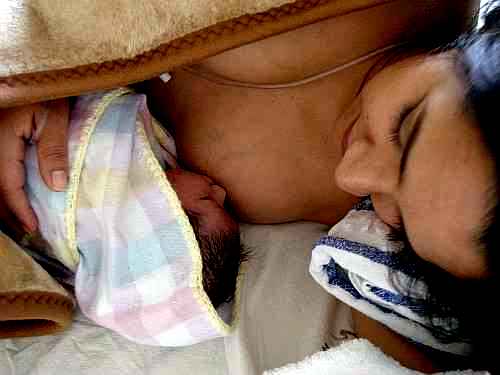
   Again, the reason why loving care matters is that's what we want for our mothers. Every patient is a child of God in need of help. Every patient was born from a mother. How can we ensure that the culture in which we work creates that kind of care?

   Some people think gaining across-the-hospital consistency is impossible. Fortunately, they are mistaken. One of the great examples of consistency in loving care (competence and compassion) is the Mayo Clinic in Rochester, Minnesota. The Clinic advances "The Mayo Way." This culture is so imbued in the staff that anyone who departs from the standard is invited out of the organization. Millions of patients have experienced this level of excellence and consistency. The culture feeds on itself breeding an environment of world class care.

   Culture determines behavior. A loving culture breeds loving care. A mediocre culture tolerates sub-standard performance and makes no efforts to accomplish meaningful change.

   Inconsistency in loving care is a classic illustration of the difficulty in applying what we all believe. We all want love. Most of us lack the courage and persistence to insure that it is practiced in the sacred environments of caregiving.

   Other hospitals besides the Mayo Clinic (Parrish Medical Center in Titusville, Florida, for example) have established high levels of consistency. Every hospital and hospice can do this. It is not a question of understanding, it is a challenge to the will and to skill informed by God's Love.

   The Mother Test is the only one that matters. Can your organization pass it? How can culture be changed so that this test can be passed?

-Erie Chapman 

First photo, above, Erie Chapman, 1978. Second photo, stock image.

Posted in

6 responses to “Days 75-78 – The Mother Test – Why Loving Care Matters”

  1. ~liz Wessel Avatar

    This reflection challenges us to continually strive for excellence. The questions you pose are compelling to say the least. I think the place to look for solutions with consistency is at a systemic level. Are systems and processes streamlined to provide and sustain skillful and compassionate patient care? It begins at the hiring process, orientation and ongoing mentoring of caregivers. I believe that caregivers want to provide loving care but need the tools necessary to be successful. As leaders we must continually ask ourselves if we are setting up conditions that will lead to success or are we chasing after mistakes, redundancy, or rework because of inefficiencies. Electronic medical records, adequate staffing and resources, and leaders who will jump in to help caregivers are foundational considerations.

    Like

  2. Victoria Facey Avatar

    I’ve noticed that the news stations have recently spoken of the healing power of prayer possibly being a factor in the outcome of patients in the hospital, especially those who have surgery. This is good news, given that some large entities don’t wish to acknowledge religion – or “this loving care” stuff that you mention in your opening story. These acts are so important to those who enter the hospital. They are often in fear, in denial and with a strong desire to be with loved ones, especially their mother.
    When visiting my father in another state, I knew I would only be there a few days. However, the nurses and aides in the hospital doted on him. Believe me, my father was happy to be there, to have the attention and appreciated the kindness given to him.
    Loving Care matters greatly to me. And for those who welcome it from their hospital beds…

    Like

  3. Marily Paco Tronco Avatar
    Marily Paco Tronco

    Loudly I want to say, Yes!!!… to your question Rev. Erie. Where I belong, where I spend 1/3 of my day should be an organization that can pass the “Mother test”, the only one that matters. How can it be? It all begins with me and my co-workers until it spreads throughout. All is possible in His power.

    Like

  4. ~liz Wessel Avatar

    I find the “mother test” to be an extremely helpful check on a personal level as well. When I engage with a distraught family member by phone I try to offer them a lifeline. I want them to know I am there for them and will help them navigate rocky waters. I frame it for myself, that if this was my mother, brother, or any loved one…this is how I would want them to be cared for by another. Like family.

    Like

  5. Julie Laverdiere Avatar

    The Mother test is a very good thermometer, I like that. It frames the response of ourselves to strangers up to family immediately. Glad to hear that there are organizations, healthcare systems, which do value and live by the mother test.

    Like

  6. Julia Wessel Avatar
    Julia Wessel

    “Your mother (or someone else you dearly love) is admitted to the hospital where you work. No one in the hospital (or hospice) knows it is your mother and you are out of town and out of touch. How confident are you that each and every person who encounters our mother will treat her with loving care?”
    This situation actually happened in our family. My daughter was 2.5 months old and admitted to the hospital and stayed for a week. After a few days, the staff connected the last names and realized she was Liz’s granddaughter, but before they knew that, they treated us and our child as if we were their family. The nurses would even drop in at night if we had the light on just to chat when the floor was quiet. Some of them shared bits of their lives with us. We appreciated that type of care and I’m glad we didn’t receive it just because our relative worked with their organization for decades! (For the record, Liz was enjoying her first vacation to Hawaii with only her husband in tow in 20 some years of marriage, so we didn’t call her to tell her that our baby was sick!) I’m very thankful that St. Joe’s hires nurses who care about their patients and take those extra minutes to spend with patients’ families too.

    Like

Leave a reply to Marily Paco Tronco Cancel reply