 As we engage the seven energies, the path to Love will zig zag in ways that often seem dizzying. One moment, we may feel we have made enormous progress. In the next, we may find ourselves so far off balance we may think we'll never recover.
This is the power in the ancient Greek myth of Achilles. The myth is over three thousand years old. And yet we know of it today (Achilles heel) as told by the poet Homer through the Illiad, a book he wrote somewhere around 700 B.C.E, hundreds of years after the story first emerged.
The Illiad describes the story of Achilles, the greatest warrior of mythology. Achilles possessed strength,honor, skill, bravery and pride. In fact, he seemed unbeatable in battle because, in most ways, he was.
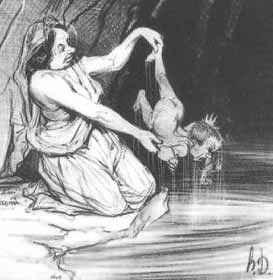
Shortly after his birth, Achilles' mother, Thetis, in an effort to make her son invulnerable dipped him in the river Styx. This provided Achilles with a shield protecting him from any assault.
But, Thetis made a fatal mistake. When she dipped her son in the magic water, Thetis held him by his heel, leaving this part of Achilles unprotected (print, above, by Honore Daumier 1808-1879.) This is, of course, how he finally met his doom, shot during battle in his exposed heel by an arrow from his enemy, Paris.
All myth is metaphor. In these metaphors lie truths for all caregivers.
In our efforts to lionize extraordinary people, we forget that the greatest of saints and leaders have their Achilles heels. There are no exceptions.
This means, we can't use the weakness and failures of others, or of ourselves, as excuses to give up upon our Loving journey. The story of Achilles describes outer armor. The story of Love describes the power and energy we cultivate within.
The myth of Achilles helps us understand why Mother Theresa had periods when she doubted God; why Martin Luther King cheated on his wife; why Abraham Lincoln fell victim to depression; why Helen Keller could be accused of pettiness and plagiarism; why Gandhi often lost his temper with his wife and his followers; why Victor Frankl was angry and impatient with those who disagreed with him; why even Jesus displayed his own Achilles heel as he questioned God from the cross.
We can look at the moments of failure by each of these saintly people and discern that their actions were wrong. It is the next step that can be treacherous. It comes when we decide that, because of these actions, these people are evil.
Why do we insist on superimposing perfection onto our fellow humans and then express shock when the objects of our admiration show human flaws? Love distinguishes between actions and the person. Actions may be wrong. This does not mean that the person is "bad." Instead, we, even the worst-acting among us, are children of God.
Mistakes tell us we are human. They are not occasions for shaming. Shame is the product of fear.
Loves forgives. Fear breeds a toxic bitterness that poisons our lives so long as we hold it.
The best we can expect from humans, and from ourselves, is that we strive to live Love and simultaneously recognize that both we and others have our human Achilles heel.
Can we still appreciate the gifts of Thomas Jefferson after we learn of his affair with one of his slaves? Can we continue to recognize the talents of a Tiger Woods (and numerous other star athletes, politicians and countless stars) after discovering his serial affairs? Can we yet suspend our finger-wagging to appreciate the genuine contributions of leaders in spite of their failiings?
Consider, further, our past leaders and the weaknesses that attend every one of their lives, For example consider Presidents Franklin Roosevelt (affairs), Kennedy (affairs), Nixon (lying and stealing), George W. Bush (early alcoholism and drug abuse, and Barack Obama (early use of cocaine.)
In the light of the failings of these titanic figures, can we as caregivers assume we are better? Who among us wants to be shamed for errors we have made? Instead, we can take responsibility and learn to understand the difference between "sin and sinner."
The story of Achilles is the story of superhuman performance and human weakness. We can make personal decisions and be accountable for our failures. Our mistakes can illuminate a brighter path – especially if we accept them not as excuses, but as explanations.
The stories of heroes and saints teach us to live not with shame, but with courageous responsibility. Love teaches us one of life's hardest lessons - how to choose Love which does not pass judgment on others, or on ourselves, as failiures occur and our Achilles heels are exposed.
Love calls us to open and enrich our inner strength. Through Love's mirror, we can see how we, as caregivers, can best serve, not how we can best criticize the efforts of others.
Through Love's mirror, we see more deeply how to follow the path of Radical Loving Care.
-Erie Chapman


 Journal of Sacred Work
Leave a reply to Karen York Cancel reply