The culture of hospitals and hospices is apparent by the stories that are told. Show me an organization whose stories focus only on finance and competition and I will show you a charity that is not living its mission. Loving organizations tell stories that portray the most powerful energy there is: Love.
My favorite parable is, of course, The Good Samaritan. This story had endured across twenty centuries and will continue to change lives far into the future.
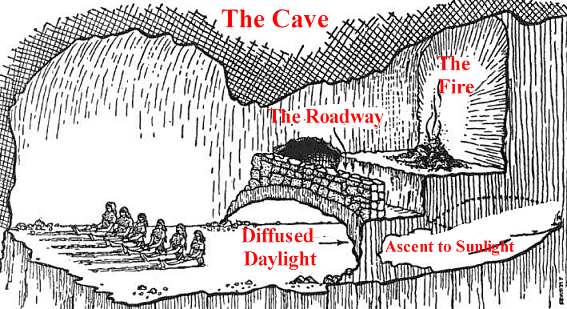 Go back another five centuries before the birth of Jesus and you will find another great parable. It is called the Allegory of the Cave and its telling and retelling are ascribed to both Socrates and Plato.
I first heard the myth in college more than forty years ago. Of all the lectures I heard during four years at Northwestern University, this story has stayed with me the most vividly. Ancient allegories can teach powerful truths to the caregivers of today.
Here is my summary of the story (very much abridged.) Imagine a person who, along with others, lives his entire life at the bottom of a cave. Everyone is chained to a large rock in such a way that they can only see, before them, shadows projected on the wall via the light cast by a fire burning behind them. Because of their chains, they can look neither right nor left.
Pause for a moment to consider this fanciful image. Because all the people at the bottom of the cave can only see shadows, that is their entire concept of reality in the world. They are like natives in the Philippines who have never left the jungle (or we, who have never seen their world.) They are like some of the people caregivers treat who may have little or no knowledge of the human body they occupy.
Now, imagine that you are one of the prisoners and you are released. You discover fire. You discover the three dimensional world. You are amazed and want to go back and tell your friends.
Instead, a guide takes you on a journey out of the cave. You see trees, birds, hills, clouds. You see the sun.
Now, you are even more excited to carry your discovery to your friends. You return to the bottom of the cave, resume your position beside your lifelong colleagues, and tell them what you have seen, heard, smelled, touched, tasted.
How do they react? In the allegory, instead of being enchanted, the people in the cave presume that the man who is returned is completely crazy. Instead of celebrating him, they want to kill him.
In real life, this is what happened to Socrates. He told the truth in such powerful ways that he was compelled to take a lethal poison.
What happens when we develop an exquisite sense of Love? We experience an epiphany. We see the world in entirely new ways.
In other words, we enter a different, higher consciousness. In this consciousness, a state often entered by artists and saints as well as caregivers, we see the world from a new vantage point. Those who have not attained this consciousness cannot be expected to understand us unless they are unusually empathetic.
Our role is to seek to communicate a pathway to this consciousness through the example we set. Further, we need to find the eloquence that will help us tell the story of what Love means and how critical it is in our world. This is what Jesus offered. This is what all the saints and the great tell us with their lives. And this is what everyday saints say with the way they give care.
This altered state, this epiphany, sometimes occurs when longtime caregivers suddenly experience a hospitalization of their own. Suddenly, perhaps for the first time, they come up out of the cave of ignorance and discover how it really feels to be a patient – the profound helplessness, the pain, the humiliation, the need for healing.
Now, they want to tell everyone. Unless they are unusually eloquent, they will find themselves ignored, perhaps even ridiculed.
What happened to Jesus when he described his message of Love for all? Yes, he found followers. More often, he encountered skepticism, ridicule and, finally, crucifixion.
As I go about the country telling telling stories and describing the concept of Radical Loving Care – a concept which is derived entirely from my sense of the Christian tradition - I find followers of this gospel of Love. Much more often, I encounter doubt, skepticism & cynicism. Sometimes, CEO's ridicule my use of the word Love. Most CEOs, particular the males, are stubbornly unwilling to engage the change necessary to become a Healing Hospital through Radical Loving Care.
Of course, no one threatens to kill me. Instead, they kill the idea I am advancing.
So, what is the use of the allegory? It is to encourage those who believe in Love to know that they have found the truth. It is also to affirm those who practice Radical Loving Care that they can take great comfort in this knowledge: they are engaging the most powerful energy there is.
For what is more important than Love?
-Erie Chapman


 Journal of Sacred Work
Leave a comment