“In Native American culture, a hummingbird symbolizes timeless joy and the
Nectar of Life. It's a symbol for accomplishing that which seems impossible and
will teach you how to find the miracle of joyful living from your own life
circumstances They are really spectacular birds, and have a lot to teach a
person about self-discovery and healing.” ~Ted Andrews
Did you ever want something in your life and then suddenly
you begin to see the object of your desire wherever you look? I had that
experience when I was in my 20’s and I was hoping to become pregnant. Suddenly,
wherever I went I saw pregnant women, it amazed me.
Most recently, I am having a similar experience, only with
hummingbirds. One day my husband Woody declared, “There is a hummingbird nest
in the avocado tree.” That was the
beginning. Then, friend Bonnie Callahan posted Phoebe’s web cam a phenomenal website
that hosted a live video of a hummingbird named Phoebe and her chicks Hoku and
Hope. People from around the world watched the miracle of life unfold in these
two baby fledglings.
Hummingbirds, hummingbirds, I see hummingbirds everywhere. Last
week a pair of hummingbirds danced outside the second story of my office window
for about a minute before darting back into the green camouflage of trees. It was magical.
We call the hummer who has taken residence in our yard, Alice.
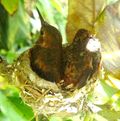 Her chicks Jade and Amber are names reflective of their colorful
feathers. We watch in fascination discovering little hummingbird nuances. Alice
is quite stern towards Woody because she doesn’t appreciate that he frequents
her backyard. Fearlessly, she approaches him darting back and forth as she scolds
him. She tells him, in no uncertain terms, that he is not welcome and to go
away. Woody hangs his head low and sheepishly retreats into the house.
 I watch Alice from
the window. She has a favorite twig in the shade of the orange tree where she
perches to guard her little ones. Alice’s
chirping sounds like a Geiger counter. The clicking sound she makes accelerates
when one draws near signaling her distress over perceived danger.
Mother hummingbirds are very protective of and committed to caring
for their young. Feeding her chicks is a full time job. She looks back and forth scouting for threats
before she dips her long beak into the babies’ mouth offering regurgitated nectar and protein from insects as nourishment. Each
time she returns to the nest her wings sound like mini jet propeller. How
precious, when she cuddles her young by affectionately rubbing her head gently
on her chicks’ neck feathers.
After about 21 days, the
chicks are ready to leave their nest. For a few days before leaving the nest, they
practice balancing and spreading their wings on the nest’s rim until they finally muster the courage to take a plunge and fly free.
For a few days afterward, mom will continue to feed her chicks and show them
where to find all the good flower spots to eat at until they are on their
own.
Hummingbird
facts from the Internet: The average lifespan of a hummingbird is five years but they can live
for more than ten years. They are the
smallest species of birds in the world, native to the Americas.
They are very smart creatures and can remember all the flowers they visited and
know just how long it takes a flower to refill. On average, a hummingbird will
visit 1000 flowers per day for nectar and needs to eat about seven times per
hour. A hummingbird’s wings beat about 70 times per
second and up to 200 times per second when diving. They are the only birds that
can fly both forward and backwards and can also hover in mid-air, fly sideways
and even upside-down and can rotate their wings in a full circle. A hummingbird
can fly an average of 25-30 miles per hour and can dive up to 60 miles per hour. A hummingbird's heart beats up
to 1,260 times per minute in flight and 250 times per minute at rest. She will
take about 250 breaths per minute while at rest and has a metabolism that is
roughly 100 times that of an elephant. Hummingbirds have very weak feet and can
barely walk. They prefer to fly and like to perch. When hummingbirds sleep at
night, they go into a hibernation-like state called torpor. Some hummingbirds migrate and will travel over 2,000 miles twice a year.
~liz Sorensen Wessel
Hummingbird
Only a glimpse
at shimmering speed.
a presence so grand
stunning indeed.
a sign of great love . . . the hummingbird
By ~Desi
Faraci Leavitt
|
|


 Journal of Sacred Work
Leave a reply to Suan Geh Cancel reply