"I studied a minute…I then says to myself, all right then I’ll go to hell, and tore it up…” – Huck Finn – from Huckleberry Finn, by Mark Twain
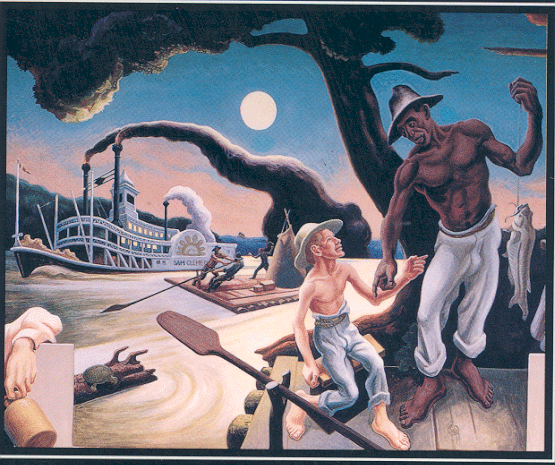 What did Huck Finn tear up? It was the paper that would have cast his friend (and slave) Jim back into the hands of slaveholders.
Finn decided he couldn't follow the slave laws of the time. Instead, he chose to save his friend – and that Jim was, in fact, fully human – not "three-fifths of a person" as the U.S. Supreme Court of the time had decreed.
In mid-nineteenth century America, anyone who tried to help a slave escape was subject to arrest as well as eternal damnation according to many southern churches. If you were a white caregiver in a southern hospital in 1950, you would not be allowed to care for an injured black person. In fact, black people were turned away at the door to the Emergency Department and directed to a charity hospital.
In Huckleberry Finn, when Huck tore up the paper, he presumed he would literally go to hell. The moment he forgot about his own salvation in favor of another's, Huck Finn expressed true Christianity – what we call, in a caregiving context, Radical Loving Care.
If I had grown up in the mid-twentieth century south, where I live today, and attended a church within a few minutes of my current home, Protestant pastors and their congregations would have taught me to follow the politics of segregation and exclusion. Many Catholic clerics would have done the same.
Indeed, a black friend of mine who was among the first to participate in the integration of a Nashville Catholic school in the 1960s was told by nuns that she was "not as smart as the white children."
Black people would not even have been allowed to worship in most Nashville churches of that era. They would not have been allowed to sit with whites at a lunch counter until 1961.
Our ability to dehumanize others is astonishing. Something in our original sin of pride often seems to push us to want to raise ourselves by demeaning others. Something within most of us wants to pursue our own salvation by taking an elitist religious path that only people of our particular denomination can travel.
In India, the poor are still shunned by many, including too many caregivers, as "untouchables." In parts of Africa, members of the Hutu tribe, including some caregivers, discriminate against members of the Tutsi tribe and vice versa. In Europe, Serbians, including caregivers, discriminate against Croatians. In the Middle East, many Muslims, including caregivers, discriminate against Christians and Jews. In Israel, many Jews, including caregivers, discriminate against Muslim's. And on and on.
How can American caregivers avoid discriminating a bit themselves? Can we really "see" the person in the ER wreaking of alcohol as fully human? Can we really "see: the patient in room 4027 as more than a "gall bladder?" Can we discern the elderly male in the patient gown as equal to us or will we persist in calling him "that sweet little old man" and treat him like a small child?
One of the strange conundrums of salvation is that if we pursue it for ourselves, we cannot attain it. Yet, if we pursue salvation by helping others, even when we don't want to (when it is most important) how can we avoid thinking that this kind actions might gain us "a few points with God?"
Some have determined how to do it. Jesus showed us the way. So did Mark Twain through Huck Finn.
The moment we say we're willing to "go to hell" in order to help another, grace arrives. For it is only then that we are living Love, not fear.
-Rev. Erie Chapman
*Painting of Huckleberry Finn and Jim by Thomas Hart Benton


 Journal of Sacred Work
Leave a reply to Suan Geh Cancel reply