"The beauty of art is beauty born of the spirit and born again." – G.W.F. Hegel (1770-1831) - Aesthetics. [At left, Adam & Eve – Sistine Chapel – Michelangelo]
http://www.youtube.com/watch?v=EvxS_bJ0yOU
(Click on the link above if you'd like to enjoy a Chopin Nocturne which reading this entry.)
As I write this, snow falls in slow motion outside my window. Chopin fills the room beside a wood fire. A Christmas image of our grand children in pajamas sits on the table nearby.
Does this image give you a sense of beauty or do you envision beauty in quite another way? What matters is that we find what we believe is beautiful for us and that we choose to swim into it as far as we can, to carry beauty with us as we enter ugliness, to learn how to hear the many shades in her voice.
Beauty is simultaneously fleeting and always present.
On October 17, 1818, John Keats wrote to his friend, R. Woodhouse, "I feel assured I should write from the mere fondness and yearning I have for the Beautiful even if my night's labours should be burnt every morning and no eye ever shine on them."
Keats tells us how to experience Beauty in the moment rather than worrying how long it will last.
For me, the work of our finest artists continually confirms that the female is the source of beauty. Everything pleasing to the eye - flowers, the moon, a bowl of fruit, the rise and fall of waves, the hills and valleys that make landscape appealing - are all derived from the curves that define the female. Male energy, on the other hand, is more straight than round, more tough than soft, more war-like than nurturing.
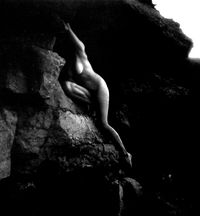 In spite of this truth, too many are troubled when they encounter some forms of beauty. For example, what about an image of female nudity? It doesn't seem to matter to some whether the nude is presented artistically or degradingly. It's "wrong" either way – even if it adorns the ceiling of the Sistine Chapel.
Perhaps, you will see beauty shine through in the lines of the model, at left, and in the rocks against which she leans. I made this image more than thirty years ago as a study of soft against hard. If you see beauty in this picture, where do you find it?
Are you able to carry beauty within you so you may withdraw it from your heart to bring you serenity as you travel your day?
"The imagination is like a lantern," John O'Donohue wrote. "When our eyes are graced with wonder, the world reveals its wonders to us."
Our eyes find grace when we see the world with respect. When this grace arrives, beauty suddenly appears in the wrinkles of an old woman's face, in the shape of an otherwise ordinary rock, in the center of a violent storm.
Likewise, when we see with sacred eyes, our world of caregiving becomes a place of beauty and grace as well as of pain and suffering.
Beauty is our birthright. When our eyes are "graced with wonder" we can enjoy this greatest of gifts, for beauty and Love are indistinguishable.
-Erie Chapman


 Journal of Sacred Work
Leave a reply to candace nagle Cancel reply