 There is a sacred identity that lives deep within our souls, And there is the identity we project into this world. Love lives in both places.
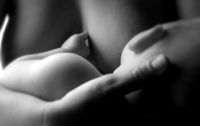
The image at left represents one of the crucial ways we find Love in this world. It happens at birth. Love comes to us through the sensation of our skin against our mother's.
Our skin remembers. It recalls, at a level that is holy, the most meaningful times it has touched and been touched – whether by the hand of Love or by the knife of hate.
Every caregiver knows that babies not held from birth – ones that have no skin contact in their first months of life - often die. This can only reinforce the criticality of skin meeting skin.
Our maternal encounter brings us more than physical warmth and sustenance. It signals that there is someone in this world who loves us.
For the rest of our lives, we seek reinforcing signals about this. We yearn for the maternal caress we knew as infants.
As adults we are, of course, warned toward "appropriate" kinds of touch. Accordingly, we reserve our most important and vulnerable skin contact for those we love most. Yet the contact we allow most – through hands and hugging – is a key part of our humanity.
Skin contact is a signal of human recognition. We send physical energy, mostly through our hands, to all others around us. For we are not suited up like astronauts to orbit the earth but to live on it. All but the most hermit-like among us need to touch and be touched across our journey through life.
Touch is as important to the elderly as it is to infants. Tragically, wrinkled and aging skin often turns people away from touching the oldest among us. What does it tell us about depression in nursing homes?
Before they've received any training, the best potential caregivers already understand the importance of touch. After years of experience, they appreciate this even more as they learn who needs close contact and who prefers more distance.
When we are struck down by disease, we discover that it is often only caregivers who are willing to touch us. At a time when we are most fragile we may suddenly feel "untouchable" by those we care for most.
This is why one of the most important aspects of healing is not what we do with drugs or scapels, but how we heal with our hands. As his fingers stroked blind eyes and on the skin of lepers, Jesus taught us the power of skin against skin.
Love leads us out of ourselves and into intimacy with those in need. Who is more helpless and in need of Love's touch than a newborn baby?
Ah, but babies are easy to Love. What about the rest of us?
Do we ever outgrow our need for the kind of Love we experienced when our mothers held us close?
-Rev. Erie Chapman
Photograph, "Skin – Study 3" by Erie Chapman (2010)


 Journal of Sacred Work
Leave a reply to moncler jackets Cancel reply