"[Photography] is a view of the world…which confers on each moment…the character of a mystery." – Susan Sontag, On Photography
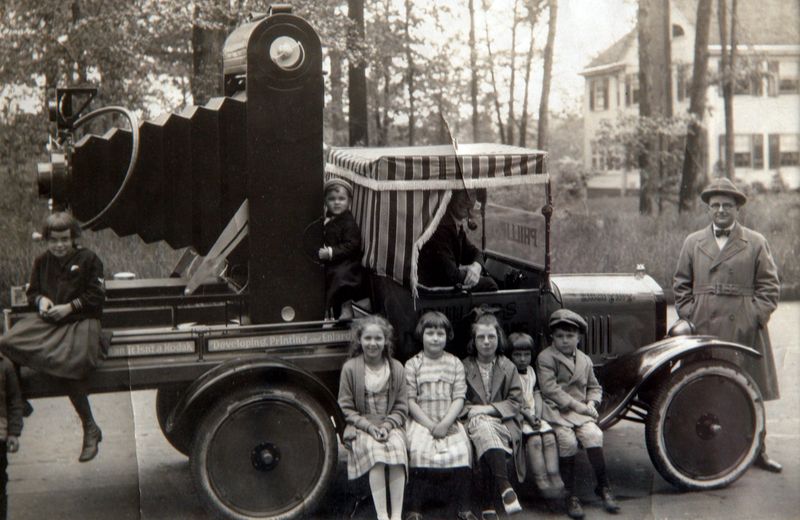
It's just a snapshot, the kind that appears in millions of scrapbooks and, now, in computer files. We "see" with our five journalistic questions: Who is that? Where, When, How, Why?
Then comes the mystery. What mystery informs this picture?
Sontag wrote that "…most photographs do not keep their emotional charge." It's hard, especially today, to hold the power of most images for long. Further, the "emotional charge" may change as we alter from within.
Consider what time does to the energy in our pictures - especially those strange images we call "snapshots." The very name suggests a quick look – nothing enduring – just a glance.
Part of the power of photographs, Sontag wrote, is that they can "alter and enlarge our notions of what is worth looking at…"
Cues about era flood this picture. The clothes look quaint. The truck, with its hard rubber tires, looks ungainly. The giant camera speaks of the way people saw photography then (and maybe now) - as a big deal - not as a way to create art, just to record.
This photograph was made in 1921. The lone survior from that day is the little girl in the white stockings.
My mother smiles at us through nine decades. She will be ninety-nine this year.
But, this picture matters to me for more than who it includes. As a photographer, I see art here, something that rises above the intention of the craftsman as the image shimmered up to him through the "stop bath" in his darkroom.
Like starlight, the energy of a picture may take years to reach us, to turn some page in our scrapbook of memory. Beyond the journalist's five questions, we find that the meaningful answers live deeper than our "snap-looks."
Some pictures, years after our eyes recorded them, become drenched in rising waves of feeling. They carry an inescapable power over us.
In yearbooks, we were listed as "not in picture" if we didn't show up. I look at photos of my photographer daughter today and see the little girl "not in picture."
I see a fragile newborn's photo and remember a terminally ill infant "not in picture" – a baby whose dying I witnessed ten years ago. Never named, he lived fewer minutes than my mother has lived years.
It staggers me to imagine how many pictures like that you, as a caregiver, must know.
For me, the power of photographs is how they change the way I see when I am not looking through the lens. A beautiful photograph is not made simply by snapping a shot of something "beautiful."
Photography rises to the level of art when the photographer provokes for many something "not in picture" – an encounter with Love.
Great pictures, seen with the eyes of our heart, help us discover the sacred. That is why the finest images, even those that may appear via a random snapshot, usher us into the presence of God.
-Reverend Erie Chapman


 Journal of Sacred Work
Leave a comment