 The moon is so often the image of romance, a white wafer reflecting the sun to us across our journey through the night. But, it is the sun that ancient Egyptians and Aztecs worshipped as God.
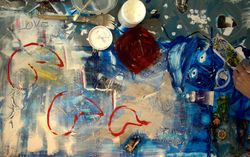
We know that without the sun, there is no life. Beneath this sun our lives, like the painting at left, are works in progress.
The reliably eloquent David Whyte reminds us of the chance life brings to us in his stunning poem, "The Sun." He writes "…I look out/ at everything/ growing so wild/ and faithfully beneath/ the sky/ and wonder/ why we are the one/ terrible/ part of creation/ privileged to refuse our flowering."
Whenever I read of life's opportunity wasted, I find myself feeling anxious about ways I have remained closed and eager to open my heart further.
"…how I want to claim/ my happiness," he rhapsodizes, "…to walk/ through life amazed and inarticulate with thanks."
Whyte mourns, with us, "the unlived lives:/ those who fail to notice/ until it is too late."
Radical Love brings us to radical presence, a kind of "noticing" that brings us closer and closer to the ecstasy of life's richest promise. In love with our work as caregivers, we see the beauty that rises from pain's departure.
"After great pain, a formal feeling comes," Emily Dickinson reminded us. We speak of the way caregiver's witness pain. We know, as well, the joy caregivers share with patients who experience relief and healing.
In love with our parents and our children, we feast on the treasures only family can bring – the memories of earliest life, the chance to know our heritage in this world, the opportunity to pass love hand to hand across generations.
In love with another, we feel the marriage of our most primal selves with the highest joy of existence. Lovers experience a kind of secret together – the intimacy that comes from sharing the most precious gifts we can offer to another.
Yet, lovers are notorious for squandering this gift through bitterness and remorse instead of celebrating forever the joy of traveling the stars hand in hand.
In his final lines, Whyte reveals, "…there is more/ to lose/ than I thought/ and more at stake than I could dream."
It is our very life that is at stake. Why not live our dreams? Why not love with every fiber of our being, with every breath we take, with every chance we have to touch the earth and sing to the open-hearted sky? Why not reach for the sun?
-Reverend Erie Chapman


 Journal of Sacred Work
Leave a reply to Marily Cancel reply