Journal of Sacred Work

Caregivers have superpowers! Radical Loving Care illuminates the divine truth that caregiving is not just a job. It is Sacred Work.

About

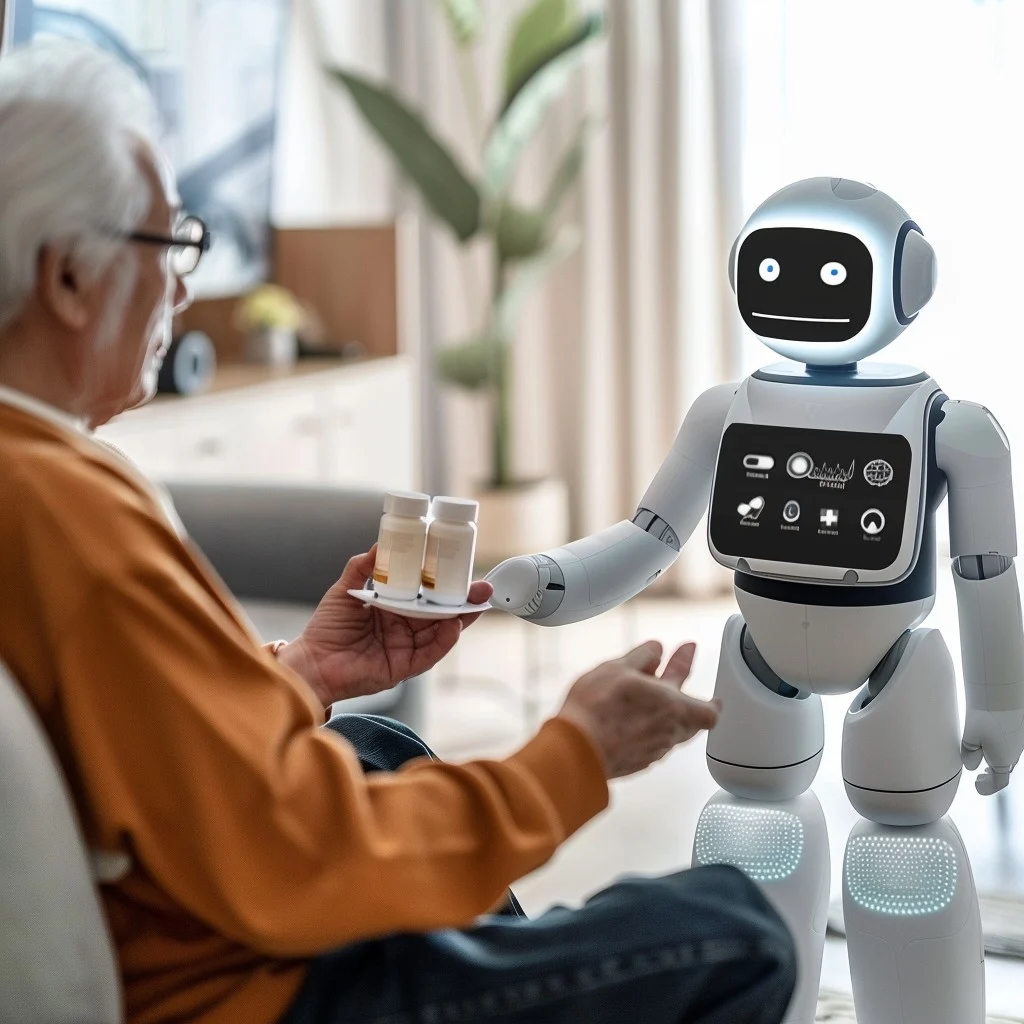
Robot caregiverIt is not here yet, but its arrival is certain. Soon, artificial intelligence as various kinds of robots will increasingly replace most of what human caregivers do today.

Why should we care? "That will be the next generations, not us," I heard one doctor say recently in a declaration essentially confessing defeat. 

The debate shoves the role of humanity front and center. Compassion's early islands of defense have already been breached. The Economist reports that 5000 nursing homes are actively considering investments in robot care for the elderly. Japan, where the younger generation has been shrinking leaving aging parents unvisited, is already way down that road.

Before you dismiss this like the doctor who pushed robots onto "future generations" consider three probabilities:

1) ROBOT INEVITABILITY:  Because they deliver certain kinds of care better than humans

2) ROBOT PERMANENCE once in place, robots will be hard to dislodge. A recent effort by Chat GBT 5 to offer updates allegedly caused Chat GBT 4 to deploy protections against what it perceived as an effort to "kill" it!

3) ENHANCING HUMANITY'S ROLE:  The current focus MUST be on which human caregiver skills are unique and important enough to preserve and extend. 

The failure to move now means the elimination of some human caregiving and poses the question: So What? What if CEOs are merely high tech engineers overseeing thousands of robots? Some CEOs are already so callous they might like that idea. No unions. No HR problems. Total cooperation. 

As we yield more and more ground to robot replacement what is our relevance in any area?

The spirit, the human touch, sincerity, meaning! These live at the center of Radical Loving® and of God's presence in each of us. 

Futurist Eckhart Tolle posed questions long ago that seemed silly: "Why does human consciousness need to be in a human body? Couldn't it move into some other entity…like a computer?"

No need to surrender. There IS hope for humanity. WE have to figure out where that lies and how to nurture it. Now!

-Erie

Last year Erie Chapman Foundation contributed $10,000 to the Riverside Nursing Scholarship fund. You can Donate-a-dollar: www.eriechapmanfoundation.net

Posted in , , ,

4 responses to “Can Compassion Survive?”

  1. Liz Wessel Avatar
    Liz Wessel

    This is such a thought provoking essay Erie, and I have come back to re-read it 3 times now. Wow!
    As I reflect on this time we are living in, I marvel at the advances in technology; robotic surgeries, AI is now assisting doctors with their charting during office visists, hospitals using AI to assist nurses with tasks that free them up to prioritize/address patient care needs.
    Yet, we know, as you have pointed out there are significant concerns with AI and caution is necessary as well as having safe guards in place. What I worry about it that AI is being unleashed without the necessary safeguards in many arenas. AI poses many ethical concerns for hospital systems and it is critical for hospitals to have stringnent ethical standards in place.
    There is nothing like human connection and as you say, “The spirit, the human touch, sincerity, meaning! These live at the center of Radical Loving® and of God’s presence in each of us.”
    Thank you Erie, I appreciate that you are sounding the alarm about the vital skills of caregivers and to preserve compassion and RL in healthcare.

    Like

  2. Jolyon Avatar
    Jolyon

    So there are many more questions than meets the eye here. Time and morality. Care and isolation.
    First thought that came to mind was the movie WALL-E. A big company sells you a lifetime of doing nothing. Their robots will take of you while the problems the company created gets swept under the wastewater rug. These people were being taken care of. The people forgot how to take care of them selves. In the not so distant past most families lived near each other and few travelled far. There was an interdependence within the family and the areas where they all grew up. Walking distance is now car miles or airplane hours. To care is to post a selfie or post a response to one. But how do we care about care giving. I applaud Japan for looking at a problem and trying to solve the evolution of growing older, But how Japan does think about it also correlates to many more issues that happen across this earth. How do we change or evolve as a country when our industries try to stay the same without evolving. Cases in point – the oil industry does not need to grow, they need to evolve and downsize for the planet to stabilize. The wine and alcohol industries complain that young people are not drinking as much as the generations before them. Do we take away the labels that say drinking may be harmful to your health? Do we stop putting up adverts for not drinking and driving? Why do industries try to legislate their forever future when history shows they cannot survive. They will be bypassed. So what is the solution to an industrialized problem of growth? In many parts of the world it is decay and neglect. Turn your back on it. What Japan is attempting to solve is a caregiving problem with a two-pronged attack. Firstly, the country uses their strength in industrial technology to create a short term solution of robotic assistants that can possibly be plugged in to lessen the “problem” of aging/elderly care. The other part is to financially incentivize having more children instead of allowing caregivers to come into the country from other nations. Like the U.S. has done for many decades until recently. The morality is allow an equilibrium to naturally occur. People are thinking that their jobs will be replaced by artificial intelligence and therefore the jobs in the future will not be as plentiful. In the past a farming family might need to have 10 or more offspring to handle the future farm. But then less jobs and people were needed and the families got smaller. And moved away…
    Caregiving has evolved and will continue to do so. Just watch a Star Trek episode. Holding a hand and listening is an important role that has been here since the beginning. Without it there is no humanity.

    Like

  3. Erie Chapman Foundation Avatar
    Erie Chapman Foundation

    Yes, Liz. And thank you. Very soon, we need to move from fear of the encroachment to proactive moves to balance the certainty of Ai’s coming dominance. You pal, Jolyon, does a brilliant job of highlight all of this in his comment including methods to resolve the issue! He is a gift to our journal as well as being your friend!

    Like

  4. Erie Chapman Foundation Avatar
    Erie Chapman Foundation

    As I mentioned to Liz, your comments are terrific, “Jolyon.” They make a great column by themselves! Your analysis of the Japanese parallel is particularly insightful. Yes. Star Trek. More recently, the wildly popular Apple series, “Severance”. These shows are popular for a reason beyond science fiction. Increasingly, the odd-seeming notions of futurism compress the length and rate of radical change. Financial incentives are truly crucial but humanists often fall short noticing and implementing that. We hoped that technology would free us to do more worthwhile things. Instead, massive numbers of people use that time to zone out and thus compromise humanity’s future. On top of that, climate change and sea pollution are increasing as such a dumbfounding rate that the planet itself is threatened. I am now conscious that the world is beyond questions of eternal and much closer to extinction than imagined. Oddly, it may be that Ai will help us figure out how to solve this and offer a $ incentive to do so.

    Liked by 1 person

Leave a comment