Journal of Sacred Work

Caregivers have superpowers! Radical Loving Care illuminates the divine truth that caregiving is not just a job. It is Sacred Work.

About

They listened at his heart.
Little-less-nothing!-and that ended it.
No more to build on there. And they, since they
Were not the one dead, turned to their affairs.

    -Robert Frost, from "Out, Out-"
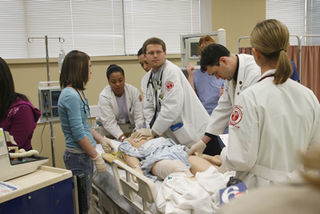
 Code team
  Having now written hundreds of entries to you, I begin to worry that I repeat myself. I know I've shared with you something I could once make happen when I was running hospitals. Now, I hope to count on you to create this in your setting. The idea is from a Harvard Medical School resident doctor who thought of it after she attended a code which "failed."
   "After the patient was pronounced dead," she said, "everyone turned and just walked away." The majesty of the team effort to save a life vanished the moment spirit left body. Each member of the code team, "…since they/Were not the one dead, turned to their affairs."
   The Harvard doctor saw a clear and elegant solution. She proposed that at the end of a code, if the patient dies, the head of the code team would simply ask the group to pause for about ten seconds "to honor the life of this person."
   I am so pleased that at least one hospital, Mercy Gilbert in Arizona, has adopted this practice. It is heart-breaking to me that Mercy Gilbert is the only place I know whose CEO, Laurie Eberst, has had the passion and persistence to make this beautiful practice come alive.
   Why is this idea so important? Because this new, caring-code ritual honors not only the humanity of the person who has died, but the humanity of the team that sought to save that life. Absent such loving rituals, the work of saving lives runs the risk of becoming transactional instead of transcendent.
   There is something you can do about this. Pass along the new code ritual idea (and perhaps this essay) to people in your organization who can implement this change. We are "not the one dead." We can turn away to other matters, or we can introduce a small and beautiful change into our corner of the world. It's a little thing, and a big thing. It's the kind of turn that opens the door to Love's light.
   What do you think? Let us know if this works in your setting.

-Erie Chapman

Posted in

5 responses to “Day 54 – A New “Caring Code” Ritual – Something to Build On”

  1. Jerald Smith Avatar
    Jerald Smith

    Erie,
    We have been observing this practice for some time. It was suggested to us by our VP of Nursing, Edwin Loftin. It has a powerful impact. In fact, I wrote a “Glimmers” about it which I am including here. I hope your imploring others to make it their professional practice works.
    Glimmers
    August 25, 2008
    “Through some moment of beauty or pain, some sudden turning of our lives, we catch glimmers of at least what the saints are blinded by…” (Frederick Buechner, Listening To Your Life, p. 169)
    In yet another one of those senseless tragedies, the medical team surrounds a broken, bleeding patient. In concert, the physician, nurses, respiratory, and EMTs, work with measured speed to stabilize him. The airway is secured, leads are attached, vitals are assessed and a stat call to radiology is ordered. The heart fails, unable to overcome the trauma he has suffered. Chest compressions begin immediately, drugs are administered and after a bit, the physician orders a pause. No heartbeat. “Let’s go again,” she says, and the compressions start anew. The “whoosh, whoosh” of the respiratory therapist’s bagging continues as a second EMT spells the first. It goes on and on it seems, but this time to no avail.
    For a moment, the team looks blankly at him, not yet willing to believe their interventions could not bring him back. I invite them to take a moment to silently honor this person whose last moments of life were with us in our Emergency Room. “Amen,” I say and the team begins to disperse. All clean their hands. Some have to clean their shoes, take a shower and don clean scrubs. They say they are OK as they resume their roles, assessing the patient with nausea in bed 9, the person with altered mental status in bed 13, and the person with chest pain in bed 1.
    In the quiet moments I have had to reflect on our experiences of that early morning, I am amazed at what we ask them to do. And thankful they are willing to do it.
    Blessings to you all,
    Jerald

    Like

  2. ~liz Wessel Avatar
    ~liz Wessel

    Thanks for highlighting this beautiful practice, Erie and for sharing your stirring reflection, Jerald. I agree it is so important to honor the person who died. This is one small but powerful gesture, as it can help caregivers’ to release some of the cumulative grief they experience. I believe this is an effective approach in keeping in touch with our humanity and can help prevent caregiver fatigue and burnout.
    Perhaps other hospitals are initiating this practice as well. It would be nice to hear from you!

    Like

  3. Erie Chapman Avatar
    Erie Chapman

    Edwin
    Thanks for reminding me of this,Edwin. I should have mentioned Parrish as well. I hope the practice is consistent throughout the hospital and happens when you aren’t there as well. Congratulations to Parrish for another breakthrough action of Loving Care!
    -Erie

    Like

  4. Victoria Facey Avatar
    Victoria Facey

    In a time where we’re all hurried, I agree that this small gesture honors one who has lost their battle of life. Perhaps this quiet observation can also be used in other places. A moment to pause and reflect gives respect and caregiving, even to those who are changed by way of transition (moving away, challenging health diagnosis,changing jobs/job loss, etc.). Sometimes we don’t always have the right words to express when things change; I think this gesture may speak volumes…

    Like

  5. Debbie Avatar

    As I read this, I thought of the many times over the years when the Code was finished the overwhelming sense of loss of the participants. This could provide a means of closure for them and others.Thaks.

    Like

Leave a reply to ~liz Wessel Cancel reply