"We are all equal. But, some are more equal than others." – George Orwell, from Animal Farm 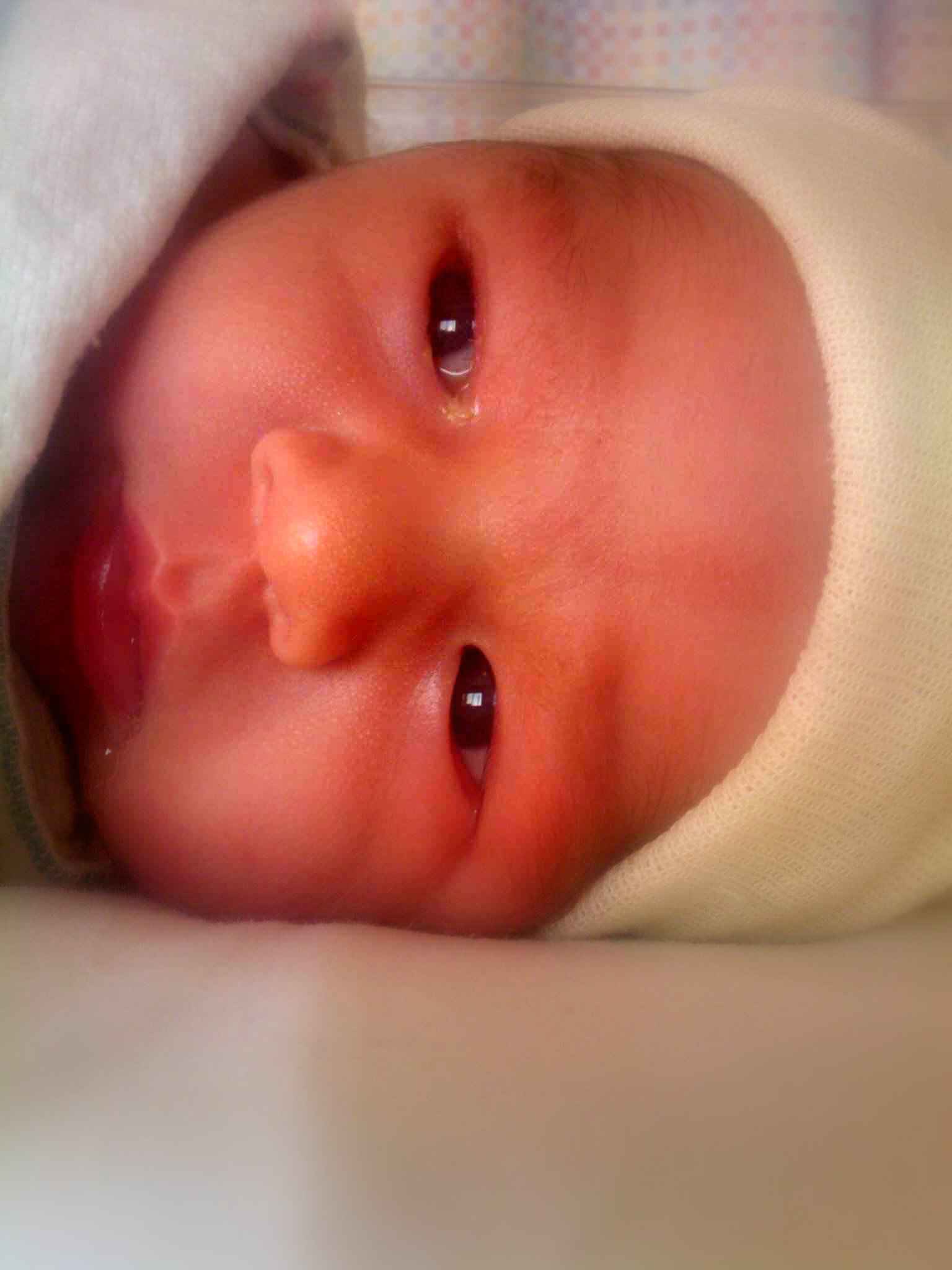
Only minutes old, my grandson looks out of his new eyes for the first time. He entered the world on May 24, 2010 in an afternoon filled with a light you see reflected in his eyes – or is that the light cast by the love of his mother and father?
What a gift he is in our lives. What luck for him – a healthy mother and father, a healthy older sister, four adoring grandparents. This healthy newborn now takes his place among humanity.
Healthy? That's the natural question everyone asks: Is he healthy?
We know he would be no less human if he were unhealthy. Or, if he had been born into poverty on the streets of Calcutta.
We know that is true. But, the world behaves otherwise. It tells us "some are more equal than others."
Society ranks and sorts us instantly. As Dr. Rollo May wrote, "One does not become fully human painlessly."
How we are labeled determines whether we are treated as fully human. How we treat others determines whether we are listening to God's Love.
In the eyes of American society were slaves human? Not according to the United States Supreme Court which ruled in 1857 (in the infamous Dred Scott Decision) that slaves should be counted as "three-fifths of a person." Native Americans, those who occupied this country long before it was taken over by European Americans, fared even worse.
Today, in the twenty-first century, are prisoners fully human? Some Wednesdays I head out to a Nashville area prison to minister to inmates. I travel through seven gates before I finally reach the area where 100 prisoners are sealed off from society. Each steel gate slams home a message: Anyone caged like this must not be as human as are we.
Once a person is convicted, our society rapidly dehumanizes them. We don't see a person anymore. We see a criminal.
When people see others this way, they have degraded another human being to becoming "less than" fully human. In so doing, they degrade themselves.
Are patients fully human? Take off your clothes, put on a patient gown, and walk into a hospital. In most hospitals, you will instantly be seen, intentionally or not, as something less than fully human. You will become "the gall bladder" not the person, "the knee" not the person, "the diabetic," not the person.
After all, you are "unhealthy" and you look completely helpless. You are weak and thus can fall victim to the strong. In the hierarchy of things, you sit (or lie) at the bottom. The folks at the top wear stethoscopes or business clothes. In the proverbial pecking order, doctor's scrubs win big over patient gowns.
If this seems like a harsh judgment, go ahead and try it. See how you do getting the attention of an overworked nurse if you're wearing a patient gown. Count how long you wait on a gurney in a hallway waiting to be x-rayed.
The human treatment of hospitalized patients got so bad that the government finally stepped in. A public website now publishes patient satisfaction statistics. Hospitals with consistently low scores may jeopardize their Medicare reimbursement status. At last, administrators began to take notice.
The problem, of course, has not been first line caregivers. It has been leaders who looked down on caregivers as "the lower employees" (I've heard this phrase many times.) In addition, our healthcare system crowds out humanity in favor of efficiency. Can't we have both?
Among the best-treated patients in hospitals are babies like my grandson (especially since circumcisions without anesthesia have fallen out of favor!) Newborns are not only helpless, but they look so cute. The elderly among us are not so lucky.
We know the answer to this tragedy. Caregivers who live Love honor the full humanity of those who come to them sick or injured or both. In a Healing Hospital, loving leaders don't look down on first line staff, they look UP to them. For it is the first line caregivers who have the greatest impact, not the executives.
The only way I know to solve the issue of patient discrimination is for us to accept that it is a real and serioius problem, to visualize a new culture flooded with loving care, and to live that culture of Love.
The reason to do this is not because either the government or a supervisor is watching. It is because God is watching.
God's Love offers the strength we need. When we open our hearts to this Love we see through a sacred lens.
With this vision, we discover that a new light surrounds those people in the hallway wearing patient gowns. It is the light that illuminates full humanity and deep vulnerability - ours as well as theirs.
-Rev. Erie Chapman


 Journal of Sacred Work
Leave a reply to Kelly Roberts Cancel reply