“To spare oneself from grief at all cost can be achieved only at the price of total detachment, which excludes the ability to experience happiness” — Erich Fromm (1900-1980)
 At a family funeral this past weekend I noticed a phenomenon common at many such occasions. Natural expressions of grieving, like tears, were viewed with marked discomfort. Some made efforts made to suppress these important human reactions.
"Gee, Aunt JoAnn sure seems to be taking it hard," someone said after noticing a sibling was crying at the death of her sister. "Maybe, we should give her a tranquilizer," another said.
"Wow, I don't know if I'm going to be able to talk," a daughter said. It was as if "breaking down" at a funeral was a sign of moral weakness.
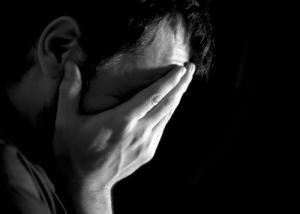
When men shed tears, the reaction is even more judgmental. Perhaps, this is why men often quickly cover their faces when "overcome."
My father used to get upset with himself when tears would leak out at the mention of his late mother. "Men shouldn't cry," he told me, echoing the rules by which he was raised and passing along the same guideline to me.
Stifled grief can cause problems of its own. Henry Wadsworth Longfellow (1807-1882) wrote: “There is no grief like the grief that does not speak” The great poet understood that tears un-shed can burn toxic within us.
Aren't tears a sign of respect for the life of the one who has left this world – a signal that we truly miss the recently departed? Doesn't every psychologist and minister tell us that tears are a good way to express sadness? After all, much as we want to celebrate the life of someone who has left this world, it is always hard to lose someone we love.
Ancient cultures marked deaths with "weeping, rending of clothes and gnashing of teeth." Some so-called "primitive" cultures continue to honor death in this way.
In New Orleans many of us have observed jazz-style funerals in which somber music is played on the way to the funeral and celebratory music is played on the way out. I"ve always seen this as a lovely approach. But, this kind of ceremony is the exception rather than the rule.
How can we best honor death in a hospital? When it happens after a "Code Blue" the code team often marks the passing as a "failure" and quickly disperses when death is pronounced.
A newer practice in Healing Hospitals is for the code team to pause for a moment to "honor the death of this person." In other words, the healing work of the code team is not done after a death. Instead, healing teams recognize that a part of good caregiving is to honor a life just passed as well as one that remains.
In general, I have seen many supervisors discourage nurses from crying with families in the odd belief that such behavior is "unprofessional." I believe this is wrong. A caregivers empathetic expression of feeling, so long as it does not interfere with medical care, is a terrific way to honor the family and friends of the deceased.
Society's rules often frustrate honest expressions of feeling in favor of a kind of Puritanical decorum. Hospital guidelines too often mimic such rigid approaches.
"Grief is itself a medicine" William Cowper (1731-1800) wrote more than two centuries ago. So, perhaps it's time for all of us to ease back on our judgments toward those who show tears as a part of grieving.
Crying is caring. So, tears are usually not a sign of weakness but an expression of caring. Isn't this what living Love is all about?
-Rev. Erie Chapman. J.D.


 Journal of Sacred Work
Leave a reply to Diana Gallaher Cancel reply